ROUND NUMBER 1
2. Which of the following cannot travel in a vacuum?
(a) a light wave
(b) a radio wave
(c) a sound wave
(d) all can travel in a vacuum
3. The frequency of the second hand on a clock is:
(a) (1/60) Hertz
(b) 1 Hertz
(c) 60 Hertz
(d) none of the above
4. From an observatory on the Earth, an un-powered satellite in a
sub-geostationary orbit around the Earth appears to overtake another travelling
in the same direction. The faster satellite is:
(a) higher
(b) lower
(c) at the same height, but moves faster
(d) cannot determine from the information provided
5. When a boat sails from fresh water into salt water, the boat will
float:
(a) lower in the water
(b) higher in the water
(c) at the same level
6. What is the third most common gas species in dry air, at ground level?
7. In what year did a man first walk upon the moon?
8. Imagine that this man had discovered that rational beings were
living in underground caves on the Moon and that they had developed a system
of units based on a unit of velocity, the 'luna', a unit of time, the 'tic',
and a unit of force, the 'fran'. In this system, what are the units of:
displacement ?
...and momentum?
9. On a humid day, water condenses on the outside of a glass of ice
water.
This occurs mainly because of:
(a) the porosity of glass
(b) capillary action
(c) adhesion of water molecules to glass
(d) the saturation of cooled air
10. What type of eclipse was observable over Tasmania on July 28th
1999?
(a) a partial lunar eclipse
(b) a total lunar eclipse
(c) a partial solar eclipse
(d) a total solar eclipse
2. Australian scientists have recently (this month) claimed to have discovered the "oldest preserved biological molecules in the world". How long ago do they claim this pushes the existence of life on Earth (to the nearest 0.5 billion years)?
3. While travelling from Hobart to Melbourne your QANTAS jet cruises at a constant speed of 200 ms-1 in level flight. The jet engines produce 4.8 megawatts of power. Calculate the force of air resistance on the plane.
4. Which planet(s) when viewed from the Earth show a range of phases like the moon?
5. Which of the following years is/are
to scheduled to be leap years.
(a) 2000 (b) 2200
(c) 2400 (d) 3000
6. Name three of the four moons of Jupiter that can be seen with good quality binoculars.
7. When the distance that incoherent light travels from a point source
is doubled, its intensity is:
(a) halved (b) doubled
(c) unchanged (d) quartered
(e) quadrupled
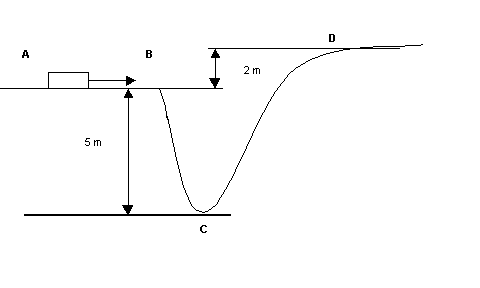
The following three questions use this information and diagram.
An un-powered roller coaster cart, of mass 40 kg, moves without
friction along the track between A and B with a speed of 10 ms-1and
then continues along the path BCD prescribed. (Assume g = 10 ms-2)
8. What is the kinetic energy of the roller
coaster cart as it moves from A to B?
9. At which point on the track is the kinetic energy a maximum?
10. What is the change in potential energy of the roller coaster
cart between points B and D?
2. An experimental aircraft travels in still air. It climbs at an angle of 45 degrees from the horizontal at a speed of 450Ö2 km h-1. After 2 minutes of maintaining this rate of climb, what is the horizontal distance covered by the aircraft?
3. If the planet Jupiter underwent gravitational
collapse, its rate of rotation about its axis would:
(a) increase
(b) decrease
(c) stay the same
4. The metastable isotope of Technetium 99 (Tc99m) is the most commonly used radioactive material in nuclear medicine. The half-life of Tc99m is 6 hours. It is used to label various pharmaceuticals which then deposit in different parts of the body and can be imaged from the gamma rays given off by Tc99m. On average a patient receives 800 megabequerels (MBq) for diagnostic imaging. If there is no Tc99m excreted by the patient, what activity remains after 12 hours.
5. Name the three ways in which heat can be transferred?
6. In what year is the next peak in solar sunspot activity (more aurora over Tasmania) expected to occur?
The following information applies to the next
three questions.
Suppose you are at a concert "Under the Stars" and
a wind blows directly from the orchestra toward you.
7. The frequency of the sound you will hear
will be?
(a) decreased
(b) increased
(c) neither decreased or increased
8. The speed of the sound you hear will be:
(a) decreased
(b) increased
(c) neither increased or decreased
9. The wavelength of the sound you hear will
be:
(a) decreased
(b) increased
(c) neither increased or decreased
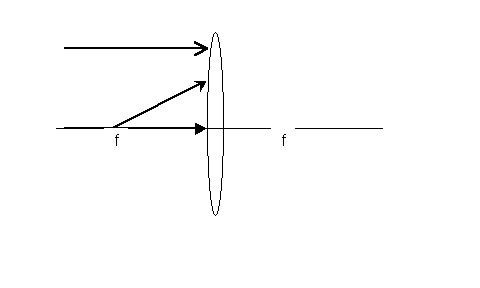
10. The following diagram shows three rays
of light incident on a convex lens of focal length f. Complete the diagram
by drawing the rays emerging from the lens.

2. An excited atom decays to its ground state and emits a photon
of green light. If instead the atom decays to an intermediate state, then
the light emitted could be:
(a) red
(b) violet
(c) blue
(d) any of the above
(e) none of the above
3. If a fixed mass of gas has its volume halved and its pressure
doubled, then the temperature
(a) doubles
(b) halves
(c) increases by a factor of 4
(d) remains the same
4. Most of a newborn baby's mass is made up of atoms whose nuclei
were made in:
(a) the mothers womb
(b) the food mother eats before giving birth
(c) ancient stars
(d) the Earth
(e) none of these
The following information applies to the next three questions:
Two lamps, one with a thick filament and one with a thin filament
(both filaments made of the same material), are connected in series to
a battery.
5. The current is greater in the lamp with:
(a) thick filament
(b) thin filament
(c) the same in each lamp
6. The voltage is smaller across the lamp with:
(a) thick filament
(b) thin filament
(c) the same in each lamp
7. If both lamps were equally efficient at converting power dissipated
into light, which would be the brighter?
(a) thick filament lamp
(b) thin filament lamp
(c) the same in each lamp
8. Approximately how long does it take for light to travel from the photosphere of the Sun to the Earth (to one significant figure)?
9. A 70 kg person runs up a flight of stairs in 5 seconds. The vertical height covered is 5 metres. Calculate the power output of the person while running up the stairs. (assume g = 10 ms-2)
10. A clock is regulated by a pendulum. If
the clock is running slow, how must we alter the length of the pendulum
to correct the rate?
2. The variety of colours seen in the aurora come from :
(a) sunlight scattered off ice particles
(b) fire in different temperature regions of the upper atmosphere
(c) electron transitions in various atoms, molecules and ions
(d) absorbing gases between the aurora and the viewer.
3. How will the force between two like charges change if the magnitude of both charges is doubled and the distance between them is halved?
4. Suppose you lived on the Moon. Suppose the Earth was directly
over your head. Approximately how long before you would see the Earth set?
(a) 1 day (24 hours)
(b) 1/4 day (6 hours)
(c) 28 days (the time it takes the Moon to orbit the Earth)
(d) 7 days (a quarter of the time it takes the Moon to orbit the
Earth)
(e) never
5. An object is in free fall. At one instant, it travels at a speed
of 50 ms-1. Exactly one second later, its speed is about (neglect
air resistance; assume g = 10 ms-2):
(a) 25 ms-1 (b) 50 ms-1
(c) 55 ms-1 (d) 60 ms-1
(e) 100 ms-1
6. A dam is thicker at the bottom than at the top because:
(a) water pressure is greater with increasing depth
(b) water is denser at deeper levels
(c) it looks better
(d) none of these
7. The number of electrons delivered daily to an average Tasmanian
household by "Aurora Energy" in 1998 was approximately:
(a) zero
(b) 24000
(c) a huge number dependent on average power usage
(d) none of these
8. Give two practical examples of where Doppler shift measurements are used.
9. Which is the best estimate of the volume of an average human adult?
(a) 0.006 m3
(b) 0.06 m3
(c) 0.6 m3
(d) 6 m3
10. (This question was faulty and has been withdrawn.)
ROUND NUMBER 6
2. Pillars of light linking the tops of thunderstorms (~15 km) to
the lower reaches of the ionosphere (~90 km), lasting a few tens of milliseconds,
are called:
(a) quarks
(b) fairies
(c) gnomes
(d) sprites
3. If a visible light signal and a radio signal were emitted simultaneously
from Alpha Centauri, the first to reach an observatory on the Moon would
be the:
(a) radio signal
(b) visible light signal
(c) both would reach the observatory at the same time
4. A converging lens of a diameter 3 cm is used to image an object.
What is going to happen to the image when the lens is covered with a non-transparent
ring of an outer diameter 3cm and an inner diameter of 1.8 cm (ie only
the central part of the lens is going to be used to get an image). The
new image is going to be:
(a) the same as the previous image
(b) there would be only a part of the previous image
(c) blurred when compared to the previous image
(d) sharper when compared to the previous image
5. A laptop computer weighing 2 kg has 40 J of potential energy with
respect to the ground. Approximately how far is it located above the ground?:
(a) 0.5 m
(b) 1 m
(c) 2 m
(d) 3 m
(e) 4 m
6. Only two techniques can currently probe properties of the solar interior. Name one.
7. What distinguishes different isotopes of an element?
8. According to a simplified model of a mammalian heart, at each pulse approximately 20 g of blood is accelerated from 0.25 m-1 to 0.35 ms-1 during a period of 0.1 s. What is the magnitude of the average force exerted by the heart muscle.
9. What is the name given to clouds that form at ~85 km altitude in the polar regions in summer?
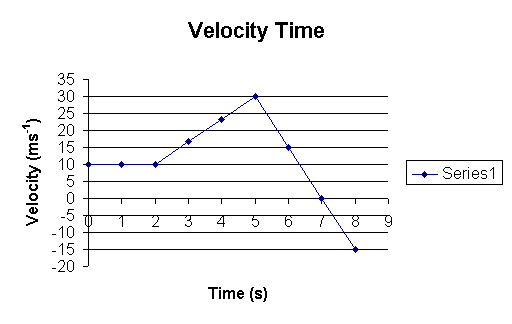
10. The velocity-time graph describes the motion of a train on a track. What is the displacement of the train from its initial position (at 0 s), after 8 s?